
Nelson Winkel
Former WRFD Member
*The Haines Index is a measure of Atmospheric Stability, i.e. how well air can move vertically in the atmosphere. The range is from 1 to 6 but I’ve rarely seen anything below 3. With a low Haines you would expect to see stratus clouds, the steam from the ethanol plant will hang around and if you were in urban areas you would expect to see expect to see increased ozone and smog/ decreased air quality. With a high Haines Index you would expect to see cumulus clouds and higher visibility due to warmer air rising and being replaced by cooler air. Seeing dust devils or whirl winds are indicators that air is moving vertically.
What this means for fire:
Under a high Haines, heat and smoke from the fire ought to rise well and can develop a large plume. Rising air with low wind speeds likely will result in occasional fire whirls/ dust devils which can cause holding concerns if they occur on the fire line. When cooler higher atmospheric air displaces the warmer rising air it can produce some light gusts around the middle of the day. If we were in large areas of timber or expansive fuels, we would expect to see a plume dominated fire where the rising heat and smoke actually create their own weather including lightning and rain such as we witnessed in 2012 at the fires by Ainsworth and Chadron. Other characteristics of a high Haines are good smoke dispersion and adequate fire behavior which we need around here due to traffic on roads like I-80 and to reduce the smoke which neighbors and people working the fires will have to deal with.
To conclude: The Haines Index is a measure of how well air can move vertically in the atmosphere and how it does play a role in predicting fire behavior and growth. Due to greater local concerns of smoke dispersion and accomplishing goals with fire rather than the creation of a giant plume dominated fire, we should be looking at a high Haines Index as a good thing.
I suggest paying more attention to the relative humidity and temperature in order to predict fire spread and spotting potential on a small scale burn.
Hopefully this helps,
Thanks Nelson
For my “Non-fire Friends” out there. You already know that water puts out fires, during the dormant season (think brown vegetation) the water in the dead grass and brush is dependent largely on the amount of water in the air. This is the -Relative Humidity. While days since rain mostly impacts how deep the fire burns the surface (and ground) fuels. NOT the rate of spread. Wind can blow a fire out -think candle- when the humidity is high or make it spread faster when the humidity is moderate.
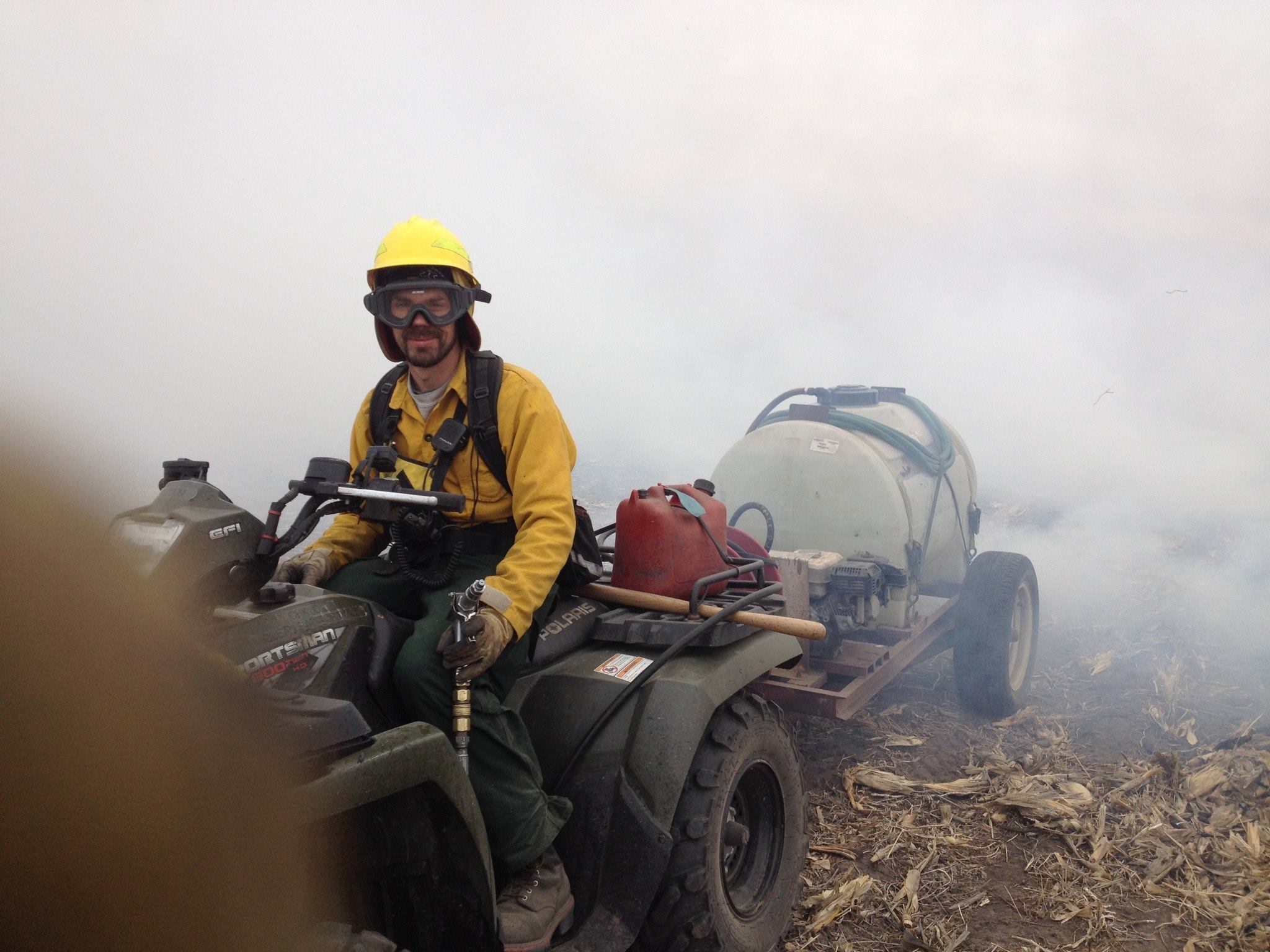
So while “Time since appreciable rain” may seem like a good way to assess fire spread risk, there are much safer and more accurate methods.
Prolonged droughts do affect live vegetation which depend on soil moisture for the water in thier leaves. These plants can also have flammable oils on their leaf surfaces to reduce drying out and they can intensify burning conditions. Conditions like this can lead to Eastern Red Cedar trees igniting easily and spreading tree to tree apart from a fire on the ground. So burn restrictions from lack of rain can make some sense during the summer months, but these are also times when prescribed burns are able to be very effective on controlling woody encroachment, something that is causing real harm to Nebraska’s rangeland and natural resources.
Thanks Nelson